
Introduction: The Documentation Bottleneck in Product Management and AI's 2026 Solution
Product managers spend an average of 20-30 hours each month writing product requirement documents. According to McKinsey, 78% of organizations now use AI in at least one business function. This represents a fundamental shift in how product teams approach documentation workflows. AI-powered PRD generation tools offer a concrete solution to the time-intensive process of creating comprehensive product requirement documents.
The global AI market is projected to reach $375.93 billion in 2026. This massive growth reflects increasing adoption across all business functions. Product management stands to benefit significantly from this technological advancement. Strategic implementation of AI tools can transform documentation from a bottleneck into a competitive advantage.
Why Claude API Opus 4.7 and Anthropic Tools Outperform Generic LLMs for Product Docs
Claude outperformed ChatGPT, Gemini, Grok, and ChatPRD in PRD generation tests according to Fireside PM research from 2025. This testing revealed Claude's superior comprehension of product requirements. The AI consistently produced more comprehensive and strategically sound documents. This advantage stems from Claude's training methodology and context window capabilities.
Other AI tools often produce generic, surface-level product requirement documents. Claude demonstrates stronger reasoning about user needs and technical constraints. The API version provides additional customization options not available in consumer interfaces. These capabilities make Claude Opus 4.7 specifically valuable for product documentation workflows.
Setting Up Access to Anthropic's Latest Developer Tools and APIs
First, create an account on the Anthropic developer platform. Navigate to the dashboard section to generate your API key. Store this key securely in your environment variables rather than hardcoding it. According to Anthropic's documentation, proper key management prevents unauthorized access to your systems.
Install the official Anthropic Python SDK using pip install anthropic. Import the library and configure your client with your API key. Test the connection with a simple prompt to verify functionality. Many developers overlook this basic verification step and encounter issues later in implementation.
Here's a basic setup script for Claude API :
import anthropic
import os

client = anthropic.Anthropic(
    api_key=os.environ.get("ANTHROPIC_API_KEY")
)

response = client.messages.create(
    model="claude-opus-4-7",
    max_tokens=4000,
    temperature=0.7,
    system="You are a product management expert.",
    messages=[
        {"role": "user", "content": "Test connection"}
    ]
)

print(response.content[0].text)
Step-by-Step: Structuring Prompts for Comprehensive PRD Generation
Effective prompt structure separates excellent AI-powered PRD generation from mediocre results. Start with a clear system prompt defining the AI's role and context. According to best practices, system prompts should establish expertise before specific instructions. This foundational step ensures consistent output quality across document sections.
Organize your user prompt into clear sections following standard PRD structure. Include product vision, problem statement, user personas, and success metrics. Specify required sections explicitly rather than letting the AI decide organization. This structured approach yields more consistent, comprehensive documentation.
Here's a structured prompt example for PRD generation:
"Create a product requirement document for a new feature. Include these sections: Executive Summary, Problem Statement, User Personas, User Stories with Acceptance Criteria, Success Metrics, Technical Requirements, and Launch Plan. The feature is [specific feature description]. Target users are [user description]. Our technical constraints include [constraints]."
Template System: Automating User Stories and Acceptance Criteria
Develop reusable templates for different feature types and complexity levels. Simple features require less elaborate templates than complex platform-level changes. According to agile methodology research, template consistency improves team alignment across documentation. This standardization reduces cognitive load during review processes.
For user stories, implement a "Given-When-Then" format template within your prompts. Specify that acceptance criteria must be testable and measurable. Include edge cases and error handling requirements in the template instructions. This comprehensive approach ensures technical teams receive actionable requirements.
An effective prompt for automated user story generation might include:
"Generate 5 user stories for the feature described. Format each as: As a [user type], I want to [action] so that [benefit]. For each story, provide 3 acceptance criteria following the format: Given [precondition], when [action], then [expected result]. Include one negative test case acceptance criterion per story."
Integrating AI-Generated PRDs into Your Existing Product Workflow
Start by identifying which PRD sections benefit most from AI assistance. Initial drafts of problem statements and user personas typically show the strongest AI performance. Technical requirements often require more human oversight and specific domain knowledge. According to implementation studies, hybrid approaches yield the best results.
Create a review checklist specifically for AI-generated content. Include items like "Verify technical feasibility" and "Check for hallucinated capabilities." Establish a clear handoff process between AI generation and human review. This structured transition maintains quality while leveraging automation benefits.
Implement version control for AI-generated documents. Track which sections were AI-generated versus human-written. This documentation trail helps identify patterns in AI performance over time. Teams can then refine their prompts based on these insights.
Quality Control and Human-in-the-Loop Review Process
Never deploy AI-generated PRDs without human review. Assign specific review responsibilities to different team members. Technical leads should verify technical requirements and constraints. Product managers should validate business logic and user experience flows. According to quality assurance research, distributed review catches more issues than single-person reviews.
Implement a scoring system for evaluating AI-generated content. Rate each section on accuracy, completeness, and clarity. Track these scores over time to measure AI performance improvements. This data-driven approach helps optimize both prompts and review processes.
Create a feedback loop where reviewers annotate issues directly in the document. Use these annotations to refine future prompt engineering. Specific examples of problems with AI output provide valuable training material for prompt improvement. This continuous improvement cycle maximizes long-term value.
Cost Analysis and ROI for AI-Powered Documentation
Claude API pricing typically follows a per-token model for input and output. According to Anthropic's 2026 pricing documentation, costs vary by model version and region. Calculate your expected monthly token usage based on average PRD length and frequency. Include both input tokens (your prompts) and output tokens (AI responses) in calculations.
Compare AI costs against human documentation time at your organization's hourly rates. Factor in quality improvements and consistency benefits beyond pure time savings. Many organizations underestimate the value of standardized documentation quality. According to business analysis, this consistency reduces downstream development errors significantly.
Here's a sample ROI calculation framework:
- Average PRD creation time without AI: 12 hours
- Average PRD creation time with Claude API: 4 hours
- Monthly PRDs created: 3
- Product manager hourly rate: $75
- Monthly time savings: 24 hours (3 PRDs × 8 hours saved)
- Monthly cost savings: $1,800 (24 hours × $75)
- Monthly Claude API costs: $45 (estimated)
- Monthly net savings: $1,755
Real-World Case Study: SaaS Team Cuts PRD Time by 70%
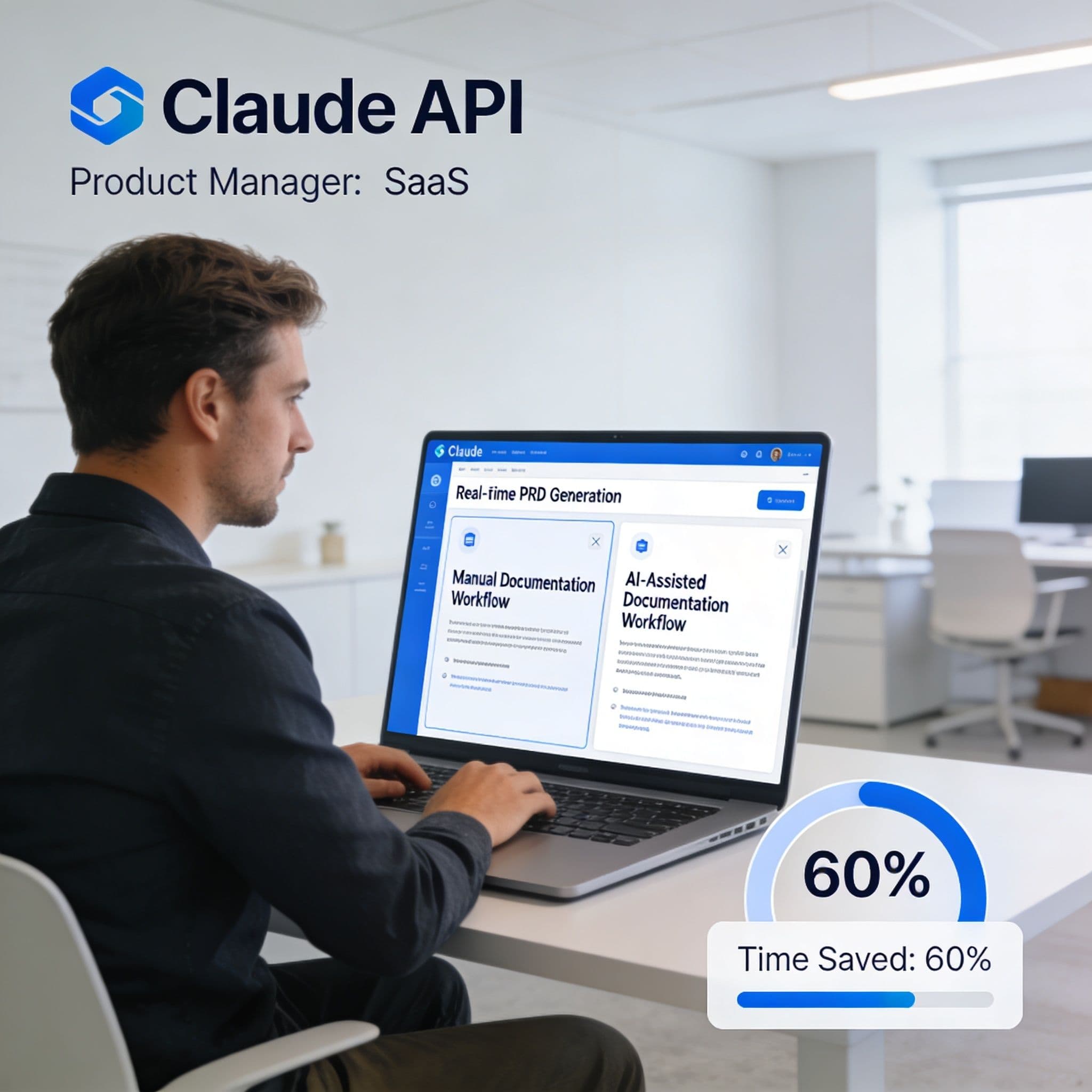
A mid-market SaaS company implemented Claude API 3.7 for their product documentation workflow. The team previously spent approximately 15 hours per PRD on average. After implementing structured prompts and templates, this dropped to 4.5 hours. This represents a 70% reduction in documentation time according to their internal metrics.
The company developed specific templates for different feature categories. They created separate prompt structures for new features versus enhancements. Each template included industry-specific terminology and compliance requirements. This customization improved output relevance compared to generic approaches.
The team reported unexpected benefits beyond time savings. Consistency across documents improved dramatically. Stakeholder reviews became more efficient with standardized formatting. Development teams encountered fewer clarification requests during implementation. These secondary benefits amplified the primary time savings.
According to their implementation report, the most valuable prompt component was explicit success criteria definition. The AI consistently generated more measurable success metrics than human authors. This improvement directly impacted feature evaluation post-launch. The team could track actual performance against documented expectations more effectively.
Future Developments and Implementation Recommendations
Monitor Anthropic's developer announcements for new tools and features. The company typically releases updates quarterly with improved capabilities. According to industry analysis, 2026 will bring more specialized models for business applications. These specialized models may offer even better performance for product documentation tasks.
Start with a pilot program focusing on one product area or feature type. Document your process and results thoroughly during this pilot phase. Use these learnings to refine your approach before broader implementation. This phased rollout reduces risk while building organizational confidence in AI tools.
Train team members on effective prompt engineering principles. Many product managers lack this specific skill set initially. According to training research, structured workshops yield better results than self-directed learning. Invest in proper training to maximize your AI implementation's effectiveness.
Establish metrics to track beyond just time savings. Measure documentation quality, stakeholder satisfaction, and implementation accuracy. These additional metrics provide a more complete picture of AI impact. According to performance management research, multi-dimensional measurement prevents optimization for the wrong outcomes.
AI-powered PRD generation tools represent a significant advancement in product management efficiency. Claude Opus 4.7 offers particularly strong capabilities for this specific application. Proper implementation requires thoughtful prompt engineering and review processes. The potential benefits justify the investment in learning and integration.